I-Pal Kagawa (Kagawa International House) Public Interest Incorporated Foundation Kagawa International Exchange Association


Notes on translation

Support for foreign residents in the event of a disaster

In recent years, earthquakes have occurred frequently throughout Japan, and disasters caused by weather changes such as typhoons and floods have also increased. As a result, interest in disaster prevention has increased, and various efforts are being made.
On the other hand, some foreign residents have never experienced an earthquake or storm or flood disaster and do not have sufficient knowledge about natural disasters. They may also have difficulty understanding information in Japanese, or feel anxious about living in an evacuation shelter due to differences in culture and lifestyle.
Therefore, in order to help foreign residents prepare for disasters with peace of mind, our association works with cities and towns in the prefecture to provide practical training for supporters (government and organization staff, disaster interpreter volunteers, foreign disaster prevention leaders, etc.).
Furthermore, we have established a multilingual disaster support center and are conducting training in communicating information in multiple languages, in order to ensure the safety of foreign residents and the local community.


■ About the Kagawa Prefecture Disaster Multilingual Support Center


When a major disaster such as an earthquake occurs in Kagawa Prefecture or its neighboring areas,
・Foreign residents who do not understand Japanese and are unable to obtain the information they need,
- Foreign residents who have little experience with disasters and are feeling great anxiety
In order to support this, Kagawa Prefecture and our association work together with volunteers such as disaster interpreters to provide disaster information in other languages ​​and visit evacuation centers to respond to individual inquiries from foreign residents.

When will it be installed?
When a major disaster occurs, the Kagawa Prefectural Disaster Management Headquarters is established, and after discussions between the prefecture and our association, it is determined that the establishment of a center is necessary.

Where will it be installed?
IPAL Kagawa, Library on the first mezzanine floor
*The location may be changed depending on the damage situation.

Who will be active?
Kagawa Prefectural Government International Affairs Division staff (including CIRs), Kagawa Prefectural International Association staff, disaster interpreter volunteers, and other collaborators


■ About volunteers such as interpreters during disasters


Based on the "Kagawa Prefecture Disaster Multilingual Support Center Operation Manual (created in 4)," our association has been registering "disaster interpreter volunteers" since 4, who have basic knowledge about disasters and are responsible for collecting and disseminating information during disasters.

What activities will you undertake in the event of a disaster?
・Responding to translation requests from the Kagawa Prefecture Disaster Multilingual Support Center (receiving Japanese manuscripts, translating them and replying by a set time)
・Disseminating multilingual disaster information using social media etc.
・(In some cases) Accompany staff on evacuation shelter visits as an interpreter and respond to inquiries from foreign disaster victims

What activities do you usually do?
Every year, we invite participants to our "Multilingual Information Transmission Training in Disasters" program, where they deepen their knowledge of disaster response through lectures and workshops by external instructors.
(Registrants will be notified by email as the event date approaches.)


Number of registered volunteers for disaster interpretation and other purposes in each language (as of February 7.2)

Western European and Latin script languages
Languages ​​in East Asia and the Chinese character cultural sphere
Diverse languages ​​of Southeast and South Asia
English
3
Chinese
(Simplified characters)
3
Tagalog
2
Spanish
2
Chinese
(Traditional Chinese)
2
Indonesian
3
Portuguese
1
Korean
2
Khmer language
1
Vietnamese
4
Myanmar
2
Nepali
1


Who can register?

・Those who are disaster prevention conscious and willing to cooperate free of charge in Kagawa Prefecture's support for foreigners in the event of a disaster.
・Those with foreign language interpretation and translation skills who will work with the prefecture and our association staff to translate and disseminate information into multiple languages ​​when the Kagawa Prefecture Disaster Multilingual Support Center is established.
・Years held by the prefecture or our association1Those who can participate in as many training sessions as possible.
・In principle, applicants must be residents of Kagawa Prefecture, regardless of nationality, and must be 18 years of age or older.

<How do I register?>
If you are interested or know someone who you think would be a good fit, please contact us.


■ Past main training contents


≪Training for supporters≫


Main participants: Prefectural and IPAL officials, disaster interpreter volunteers, foreign disaster prevention leaders, and collaborators from municipalities, supervisory organizations, etc.

Multilingual information transmission training during disasters

*Commissioned project from Kagawa Prefecture

Disaster Multilingual Support Center
Installation and operation training (internal)

・Initial response training
・Translation request exercises
・Pre-translation manuscript writing exercises

- Conduct practical reviews of the procedures for setting up and operating a multilingual disaster support center, and improve the response capabilities of those involved.
・Establish a system that allows for smooth collaboration with translators in remote locations.
- Determine the priority of information and use it to disseminate information effectively.

Information multilingual training

·lecture
·workshop

・Understand the structure of the Disaster Multilingual Support Center and the role of volunteers in translating during disasters.
・Learn from past examples about key points and precautions for communicating information in multiple languages ​​during disasters.
- Revise the pre-translation manuscript based on the translator's opinions and consider better ways to communicate information.
・<Translator> Upon receiving a request, translate the Japanese manuscript (pre-translation manuscript) and confirm the procedure for replying to the person in charge.

Evacuation shelter patrol training and consultation response training

·lecture
·workshop

- Deepen your understanding of the structure of the Disaster Multilingual Support Center and the role of volunteers such as interpreters during disasters.
- Review the procedures and check items for providing support at evacuation centers and work to improve response capabilities.
- Understand the perspective of foreign evacuees and understand the challenges and support needs they may face at evacuation centers.
- Through collaboration with various stakeholders, we aim to strengthen the multilingual support system in the operation of actual evacuation shelters.

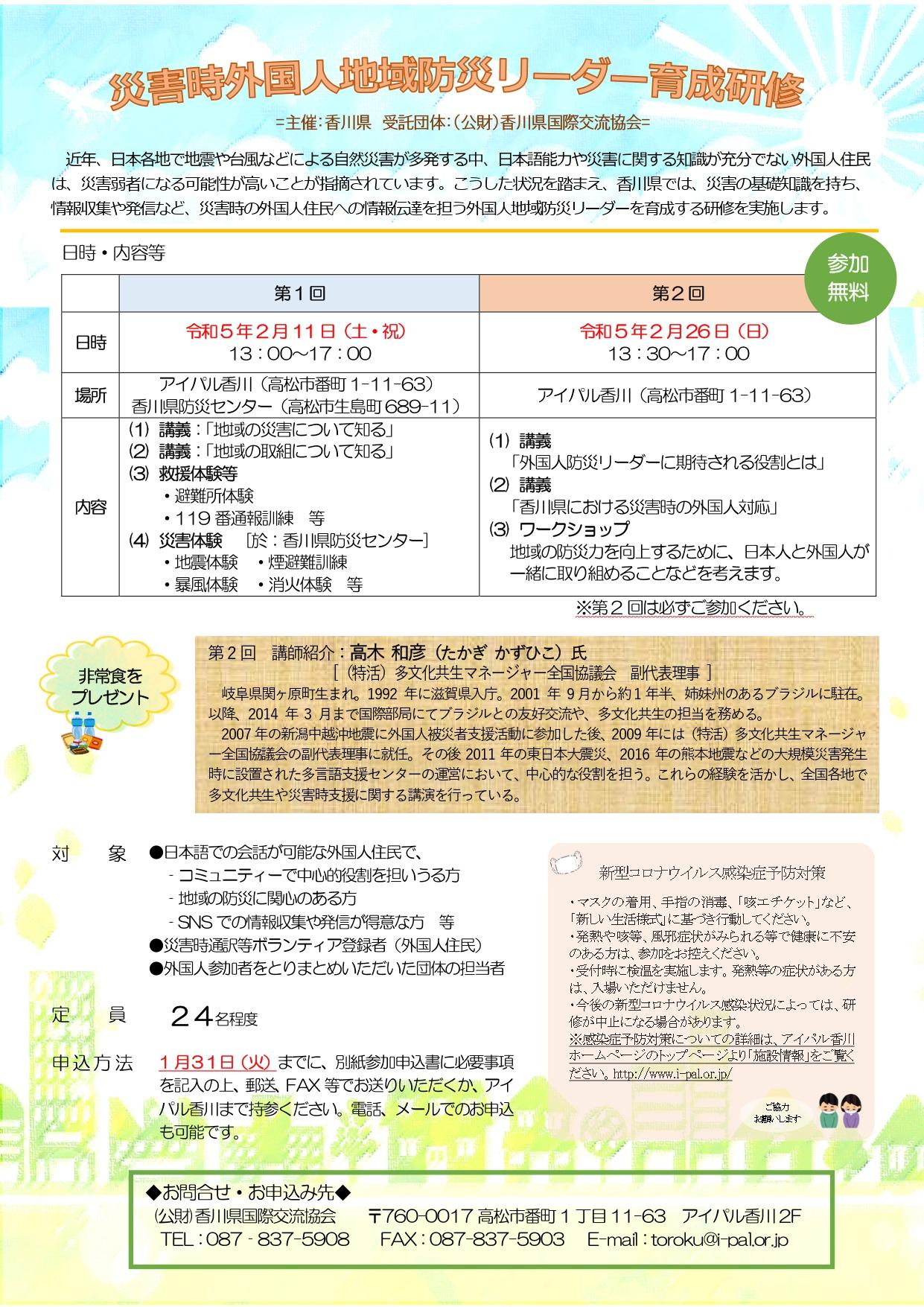
Foreign Disaster Prevention Leader Training

*Co-hosted event with Kagawa Prefecture

Basic training

·lecture
·workshop
・Disaster experience
・Experience evacuation shelters, etc.

・Learn about disasters in Kagawa Prefecture and local initiatives.
・Learn about the activities of disaster prevention leaders.
・Create a hazard map.

Advanced Training

·lecture
·workshop

・Learn about the role expected of disaster prevention leaders.
・Experience multilingual information translation and interpretation work.


<Training for residents>

Main participants: Foreigners living in Kagawa Prefecture, and local government supporters

Disaster prevention training for foreigners

Local disaster lectures

Use hazard maps and other materials to gain a deeper understanding of what types of disasters may occur in your area.

Disaster experience

Participants will have a simulated disaster experience at a disaster prevention center, etc., and learn how to protect themselves and others.

Evacuation center experience

Participants will experience living in a shelter by assembling simple beds and toilets and tasting emergency food.

Disaster Prevention Japanese Language Course

Learn Japanese vocabulary and kanji that will be useful in the event of a disaster.

Disaster-related quizzes and games
(Jointly with supporters)

Deepen interactions between participants through fun activities that increase knowledge about disasters and disaster prevention.


■ Useful links for supporting foreigners in times of disaster 

"Disaster prevention guidebook for foreign residents/ Kagawa Prefectural Government, General Affairs Department, Governor's Office, International Affairs Division

(Easy Japanese, English, Korean, Chinese (traditional), Chinese (simplified), Tagalog, Indonesian, Portuguese, Spanish, Vietnamese)


Information for foreign residents supporters


-"Search for multilingual disaster information sheets/ Council of Local Authorities for International Relations
-"Search for disaster pictograms/ Council of Local Authorities for International Relations
-"Multilingual evacuee registration card and food pictograms (FOODPICT)/ Council of Local Authorities for International Relations
· "Multilingual pointing board'/Local Government International Association
-"Glossary, phrasebook, and reference materials for language supporters in times of disaster/ Council of Local Authorities for International Relations


◎City and town hazard maps

City name

Hazard map

City name

Hazard map

One

Takamatsu

Takamatsu Disaster Prevention Map
(earthquakes, wind and flood damage, reservoir disasters, etc.)

10

Shodoshima Town

Disaster prevention related maps
(Landslides, tsunamis, storm surges, etc.)

Two

Marugame

Marugame Map
(Floods, landslides, tsunamis, reservoirs, etc.)

11

Miki Town

Miki Town Hazard Map
(floods, etc.)

Three

Sakaide

Reservoir hazard map
Sediment disaster hazard map
Flood hazard map
Tsunami hazard map
Storm surge hazard map

12

Naoshima Town

Naoshima Town Hazard Map(Japanese version)
Naoshima Town Hazard Map(English edition)
(earthquakes, tsunamis, storm surges, landslides, etc.)

Four

Zentsuji

Zentsuji City Comprehensive Disaster Prevention Hazard Map
(Sediment, floods, reservoirs, etc.)

13

Utazu Town

Utazu Town Comprehensive Disaster Prevention Hazard Map
(floods, high tides, tsunamis, reservoirs, etc.)

Five

Kanonji

Kanonji City Comprehensive Disaster Prevention Map
(Tsunami, high tides, landslides, floods, reservoirs, etc.)

14

Ayagawa Town

Flood and landslide hazard maps
(earthquakes, wind and flood damage, landslides, etc.)

6

Sanuki City

Disaster prevention and safety "Hazard Map"
(Tsunamis, reservoirs, landslides, floods, high tides, etc.)

15

Kotohira Town

Kotohira Town Comprehensive Hazard Map
(floods, reservoirs, landslides, earthquakes, etc.)

Seven

Higashikagawa

Disaster Prevention "Various Maps"
(Tsunami, high tides, reservoirs, floods, etc.)

16

Tadotsu Town

Comprehensive hazard map
(Floods, earthquakes, tsunamis, landslides, reservoirs, high tides, etc.)

8

Mitoyo

Mitoyo City Comprehensive Disaster Prevention Map
(earthquakes, wind and flood damage, landslides, etc.)

17

Manno Town

Mannou Map
(Landslides, reservoirs, floods, etc.)

Nine

Tonosho Town

Tsunami and landslide hazard maps
Reservoir hazard map
